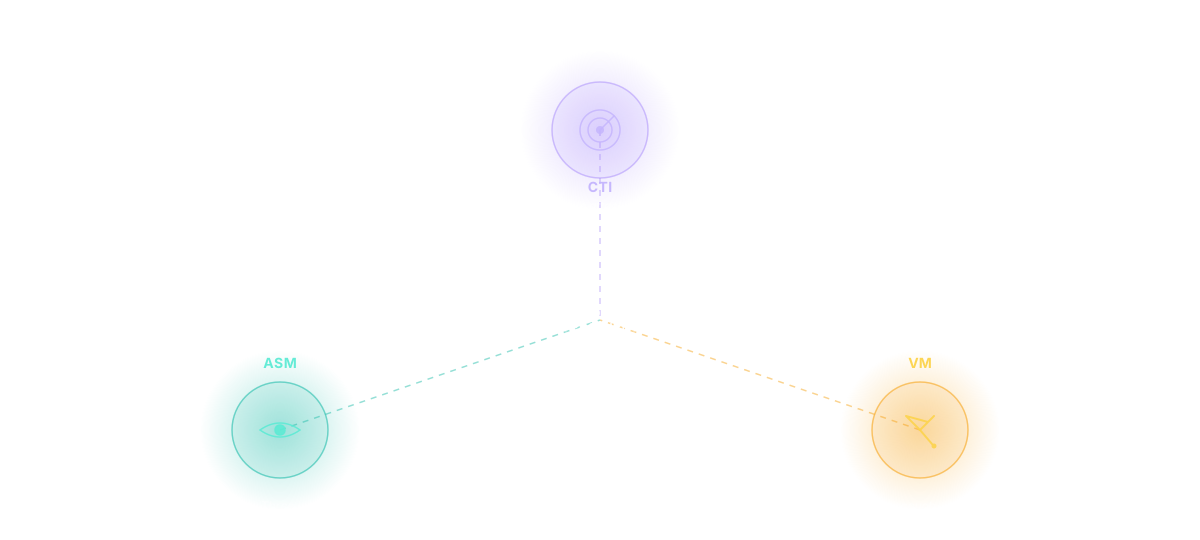
Security teams are drowning in acronyms. ASM. CTI. VM. They show up in the same vendor slides, the same procurement conversations, and occasionally the same Slack threads, used almost interchangeably by people who should know better.
They are not the same. They answer different questions, operate on different timescales, and fail in different ways when you're missing one. This post breaks each down, draws the hard lines between them, and explains why a mature programme needs all three working together.
The core question each tool is trying to answer
Before diving into definitions, start here. Each discipline exists because it answers a fundamentally different question:
| The question it answers | |
|---|---|
| ASM / EASM | What can an attacker see and reach right now? |
| Vulnerability Management | What's wrong with the assets I already know about? |
| Cyber Threat Intelligence | Who is coming for me, how, and why? |
Get that distinction into muscle memory and the rest of this post is just detail.
Attack Surface Management (ASM / EASM)
What it does
ASM platforms continuously discover, inventory, and assess all internet-facing assets across an organisation's digital footprint, from cloud instances and APIs to forgotten subdomains and third-party connections. The key distinction is that ASM works from the outside in, mapping what attackers actually see rather than what your internal records say you own.
The scope is deliberately broad. Your digital attack surface typically includes external-facing assets like ports, email servers, API keys, web applications, public cloud services, IoT devices, SSL certificates, VPNs, and web domains.
What makes it different
The main difference between ASM and vulnerability management is the way each determines the list of systems to scan. ASM builds its own list, enabling it to identify and assess unknown and unmanaged assets, while vulnerability scanners typically work from a provided list of domains.
That distinction matters enormously in practice. Organisations consistently underestimate their external footprint. Censys research has found that up to 80% of an organisation's attack surface is unknown to security teams, and those unknown assets are unmonitored, unpatched entry points.
Classic gaps ASM finds: long-forgotten dev servers, test environments promoted to production without review, public storage buckets, or assets inherited through acquisitions. Cloud environments add subtler issues too: ephemeral services, API gateways, exposed functions, orphaned IPs, or misconfigured networking rules that unintentionally create external entry points.
Where it stops
ASM tells you what's exposed. It doesn't tell you the precise CVE chain an attacker would use to exploit it. It doesn't tell you which threat actor group is actively scanning for that exposure. That's where the other two tools come in.
Vulnerability Management (VM)
What it does
Vulnerability management is the process of identifying, analysing, remediating, and managing cybersecurity vulnerabilities across an organisation's IT ecosystem. It's the discipline most security teams have had the longest, and it's the most narrowly focused of the three.
A standard VM lifecycle runs: asset inventory → vulnerability discovery across known assets using scanning tools and threat intelligence feeds → prioritisation by correlating CVSS scores with asset criticality and exploitability → remediation via patches, configuration changes, or compensating controls → verification.
What makes it different
VM is deep where ASM is wide. It focuses on the internal, software-based IT landscape, scanning known assets for code-level vulnerabilities and tracking remediation through to closure. VM solutions concentrate on a single asset or a scoped portion of the environment, without concern for how assets are interconnected or how a weakness in one cascades to others.
There's also a timing problem baked into traditional VM. Vulnerability scans provide a snapshot rather than continuous monitoring. As the speed and breadth of today's threats grow, traditional VM, fundamentally reactive, can't keep up on its own.
The scoring problem is real too. Static CVSS scores fail to reflect actual exploitation likelihood. A CVSS 9.8 that no threat actor is actively weaponising is arguably lower priority than a CVSS 7.1 that's in active exploit kits targeting your sector. VM alone can't tell you which is which.
Where it stops
VM assumes you already know what you're scanning. It doesn't find the assets you've forgotten, and without external context, it can't tell you which of the 2,000 findings on your report are the ones attackers are actually reaching for today.
Cyber Threat Intelligence (CTI)
What it does
CTI is the process of gathering, analysing, and interpreting information about potential or actual cyber threats. It's a proactive approach that helps organisations understand the threat landscape and identify risks before they become incidents.
CTI focuses on turning raw data into actionable insight that helps organisations prevent, detect, and respond to attacks. It aligns external observations with the organisation's specific context, for example, revealing that a certain malware family is actively targeting financial firms, or that a spike in phishing attacks against your sector reflects observed adversary behaviour.
CTI operates at multiple levels. Strategic CTI provides a broad understanding of the current threat environment, informing decisions around governance, resource allocation, and operational priorities. Tactical and operational CTI helps security teams rapidly respond to threats by providing the technical details needed to detect and mitigate attacks.
What makes it different
If ASM is your map and VM is your inspection checklist, CTI is your intelligence briefing on who's coming, what they're carrying, and which door they prefer.
CTI answers questions the other two tools structurally cannot. Is this threat actor group targeting organisations in my industry this quarter? Is this CVE in active exploit kits right now? Are my employee credentials circulating on dark web forums? CTI surfaces actionable insights from the clear, deep, and dark web to detect compromised identities, vulnerabilities, and active adversaries.
Where it stops
CTI without asset visibility is intelligence with no map. Knowing a threat actor is exploiting a specific nginx misconfiguration does nothing for you if you don't know which of your 400 subdomains are running that nginx version. CTI tells you what's being targeted. ASM and VM tell you whether you're actually in the crosshairs.
The hard differences, side by side
| ASM / EASM | Vulnerability Management | Cyber Threat Intelligence | |
|---|---|---|---|
| Starting point | The internet: finds assets from outside | Your asset inventory: works from a known list | Threat actor activity, TTPs, dark web signals |
| Primary output | Exposed asset inventory + posture scores | CVE findings + patch prioritisation list | Threat actor profiles, IOCs, exploit data |
| Scope of assets | Known + unknown, external-facing | Known, typically internal or scoped | Agnostic: focuses on adversary, not infra |
| Cadence | Continuous, automated | Periodic scans (often weekly/monthly) | Continuous feeds, analyst-updated |
| Answers | "What can attackers see right now?" | "What's broken in what I know I have?" | "Who's targeting me, and how?" |
| Blind spot without it | Shadow IT, forgotten assets, acquired infra | Known-good assets with hidden CVEs | All findings, no attacker context |
Why you need all three
ASM, vulnerability management, and CTI are very different from one another, yet they overlap. It's not a question of which one is "better": they complement each other.
Here's how the combination works in practice:
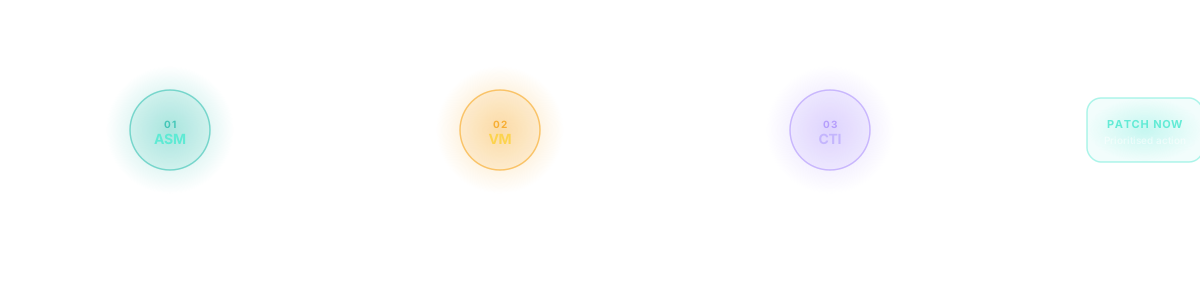
- ASM gives you the complete map. It finds the assets you didn't know you had, including the ones your VM scanner has never touched. ASM discovers unknown assets, ensuring VM scans are more comprehensive.
- VM goes deep on what ASM surfaces. Once you know an asset exists and is exposed, VM tells you precisely what software-level vulnerabilities are present and prioritises them for patching.
- CTI tells you what to fix first. Threat intelligence qualifies your ASM data by revealing which exposures are most susceptible to threats based on attacker tactics and current targeting.
The failure mode without this combination is well understood. Many organisations operate in silos: security, IT, and CTI teams independently, with limited visibility and collaboration. Each team uses different tools, sets different priorities, and adopts a different "risk language", leaving the organisation without a unified, intelligence-driven view of risk.
Rather than trying to address every attack-surface vulnerability, a threat-informed defence focuses on the vulnerabilities actually exploited by cyber adversaries. The combined approach aggregates and analyses ASM, vulnerability, and threat intelligence data to determine which assets are present, which are vulnerable, and which are actively being exploited in the wild.
A practical mental model
Think of it this way:
ASM is reconnaissance, done on your behalf, from an attacker's vantage point, continuously. Vulnerability Management is your internal audit: systematic, structured, CVE-tracked. CTI is your intelligence service, tracking who's operationally active, what they're using, and who they're hitting.
A pentest without ASM misses assets. A VM programme without CTI drowns in findings that no one is exploiting. CTI without asset context produces briefings with nowhere to act.
The three aren't competing budget line items. They're a chain. Break any link and the other two lose fidelity.
The bottom line
Nano EASM sits at the ASM layer of this stack. It starts from your domain and maps outward, finding subdomains, open ports, exposed services, misconfigured assets, and certificate issues across your internet-facing footprint, continuously. Every finding is tracked and scored so your team focuses on real exposure, not spreadsheet noise. Pair it with your VM tooling and CTI feeds, and the three together give you a defence that's both wide and deep.