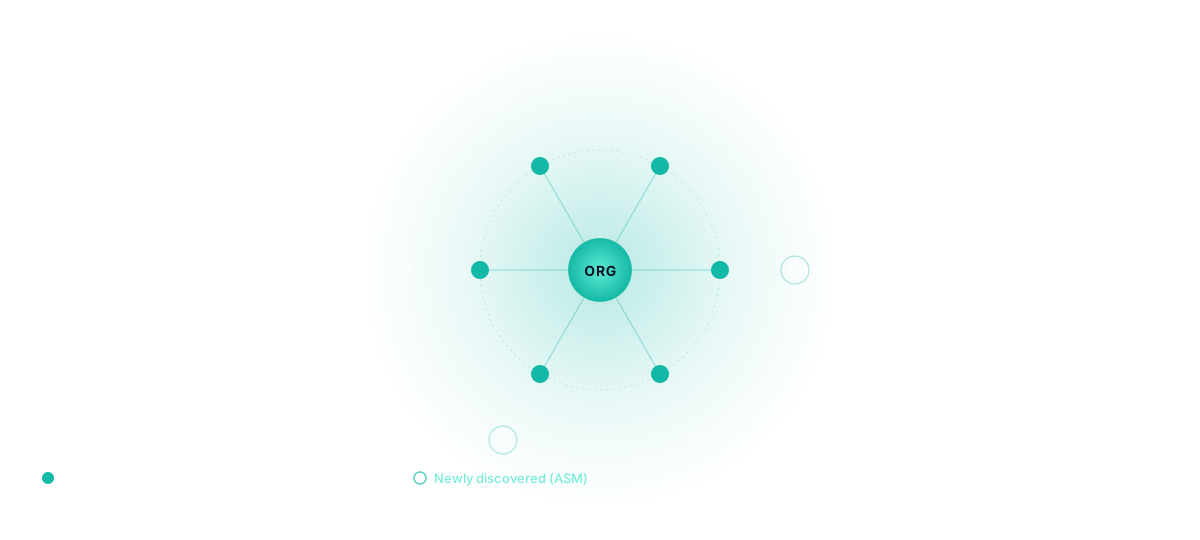
Your security team can only protect what it can see. The problem is that most organisations are running blind across a growing slice of their own infrastructure, and attackers know it.
Attack Surface Management (ASM) is the discipline that closes that visibility gap.
The attack surface: a moving target
Your attack surface is the sum total of all possible ways an attacker could gain access to your environment: through exposed infrastructure, human error, unmonitored third-party tools, forgotten test servers. It includes every internet-facing asset, every internal system, every third-party integration, every human entry point.
The catch: that surface never sits still. As organisations grow and adopt new technologies, the attack surface expands, often in ways that are difficult to see or control. Cloud infrastructure, SaaS apps, mobile devices, hybrid work, and third-party vendors have all contributed to a sprawling and often invisible digital footprint.
And it's not just scale: it's the unknown corners. Some assets are deliberate and well-documented: cloud applications, websites, domains, and external integrations. Others are faint or forgotten tracks that reemerge unexpectedly: test environments left open to the public, untracked SaaS and AI services spun up without IT approval, or leaked credentials surfacing on dark web forums.
What ASM actually does
Attack Surface Management is the continuous discovery, analysis, prioritisation, remediation, and monitoring of the cybersecurity vulnerabilities and potential attack vectors that make up an organisation's attack surface.
The key word is continuous. ASM isn't a one-time scan or an annual audit. Because the size and shape of the digital attack surface changes constantly, the processes are carried out continuously, and ASM solutions automate them wherever possible. Both the inventoried assets and the network itself are continuously monitored and scanned for vulnerabilities.
What separates ASM from most other security disciplines is perspective. Unlike other cybersecurity disciplines, ASM is conducted entirely from a hacker's perspective, rather than the perspective of the defender. It identifies targets and assesses risks based on the opportunities they present to a malicious attacker.
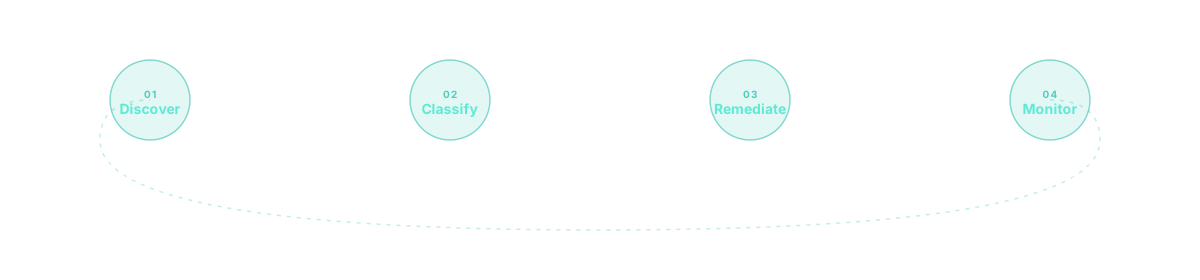
In practice, that means four repeating stages:
- Discovery: Finding all the assets that make up your organisation's attack surface, including ones no one on your team formally owns or tracks.
- Classification & prioritisation: Assets are categorised based on level of exposure, business value, and potential impact if compromised.
- Remediation: Addressing the highest-risk findings first, not working through a flat list.
- Monitoring: Continuous monitoring enables ASM to detect and assess new vulnerabilities and attack vectors in real time, and alert security teams to any new vulnerabilities that need immediate attention.
External Attack Surface Management (EASM): the outside-in view
You'll often see the term EASM alongside ASM. They're related but distinct.
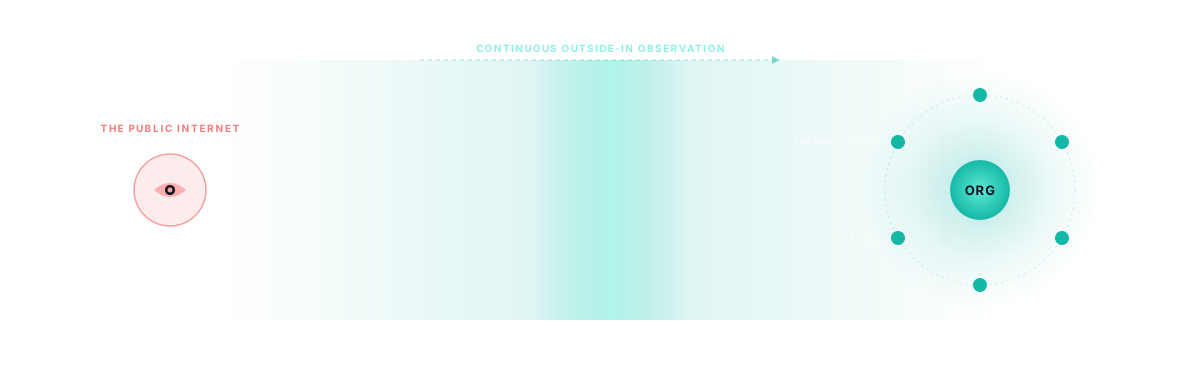
External Attack Surface Management is the continuous discovery, monitoring, and analysis of an organisation's internet-facing assets: everything visible to attackers, including domains, subdomains, IP addresses, web servers, cloud instances, and third-party integrations.
EASM is different from an internal asset management solution. It focuses solely on assets exposed to the public internet, with the goal of helping security teams understand and control the full scope of their external presence to reduce the likelihood of external attacks.
Think of it this way: ASM is the broader discipline; EASM is the outside-in lens that focuses specifically on what an attacker on the internet would see when they look at your organisation.
How ASM differs from vulnerability management
This is the question we get most often. They're complementary, not interchangeable. The main difference is in how they build the list of systems to scan. ASM builds its own list; vulnerability scanners work from one you give them.
| ASM | Vulnerability Management | |
|---|---|---|
| Scope | Everything internet-facing, known and unknown | A provided list of systems |
| Asset list | Discovered automatically and continuously | Supplied by you, often manually maintained |
| Perspective | From the attacker's vantage on the public internet | From the defender's inventory |
| Strongest at | Surfacing shadow IT, forgotten subdomains, third-party drift | Deep CVE / config analysis on known hosts |
| Weakest at | Replacing deep host-level vulnerability scanning | Finding assets nobody told it about |
Neither replaces the other. Vulnerability management remains essential for deep analysis of known systems; EASM gives you the broader, more dynamic view of what's actually exposed. Investing in both is the right answer for any serious programme: depth and breadth.
The AI factor
One vector deserves its own callout: the surge in AI use has created new vulnerabilities in large language models (LLMs) and the data used to train them. Every LLM integration, every AI-connected API, every fine-tuned model endpoint is a potential entry point that didn't exist two years ago. Most organisations are adding these faster than their security teams can inventory them, which is exactly the visibility gap ASM is designed to close.
Why it's urgent now
The scale of the problem isn't shrinking. Businesses face attack vectors, from cloud misconfigurations to zero-day vulnerabilities, that are "growing in variety and volume," according to a May 2025 KuppingerCole Analysts report.
Meanwhile, increased cloud adoption, digital transformation, and remote work have made the average company's digital footprint larger, more distributed, and more dynamic, with new assets connecting to the network daily. Traditional asset discovery and vulnerability management processes, developed when corporate networks were more stable and centralised, can't keep up with the speed at which new vulnerabilities arise.
Without ASM, most organisations are flying blind across parts of their infrastructure, leaving shadow assets and outdated systems exposed to increasingly automated and opportunistic attackers.
What good ASM looks like in practice
By viewing the system from a hacker's perspective, ASM enhances visibility and reduces the likelihood of successful cyberattacks. In operational terms, that means:
- Continuous, automated scanning: not scheduled quarterly, not waiting for a ticket. Good EASM performs continuous, automated scans that don't require specific scheduling or approval.
- Discovery-first: the process begins with asset discovery, automatically identifying all internet-facing assets associated with an organisation, including unknown and shadow IT resources. This phase often requires minimal input: just a company name or primary domain.
- Prioritised output: real-time monitoring and threat intelligence help security teams focus on the vulnerabilities that matter most, not a flat list of thousands of findings to triage manually.
- Third-party coverage: modern EASM incorporates third-party risk analysis, assessing risks from connected vendors and partners.
The bottom line
Your perimeter is no longer a perimeter. Today's attack surfaces stretch across the internet (shaped by remote work, cloud adoption, and external partnerships) with attack vectors that no longer respect the boundary of a corporate data centre.
ASM gives you a map of what you're actually defending, continuously updated, built from the same vantage point an attacker uses. That's the starting point for any serious security programme.
Nano EASM scans your external-facing assets continuously, surfaces findings by severity, and gives your team a clear view of what the internet can see about your organisation, so you can act on it before anyone else does.